
Douglas Brynes found the tortoise on a gray afternoon in upstate New York, near a place most people avoided without thinking twice.
The sewer outlet sat at the edge of an abandoned service road, half-hidden by weeds and rusted fencing. The air smelled wrong—chemical, metallic—and the shallow pool below the pipe shimmered with an oily, unnatural sheen. Douglas had only been there because he liked to walk forgotten places, the edges of things where nature and human neglect collided.
That was when he saw the shell.
At first, he thought it was debris—something dumped and left to rot. But then it moved. Barely. A slow, painful shift beneath the sludge.
Douglas ran forward.
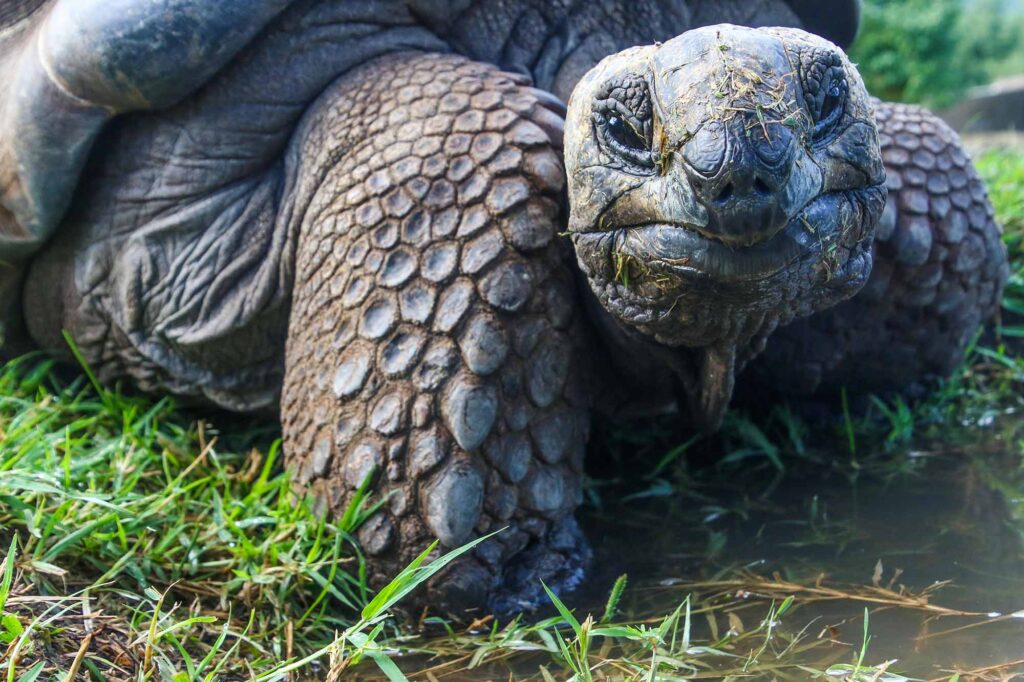
The tortoise was coated in dark, radioactive-looking muck, its shell cracked and glowing faintly green in places where the waste had soaked in. Its eyes were open but dull, its head sagging as if the effort to breathe alone was too much. Someone—somehow—had let this creature end up here, and it was dying.
Douglas didn’t hesitate.
He stripped off his jacket, wrapped it carefully around the tortoise, and lifted it free from the sludge. The shell was heavy, the body frighteningly still, but there was a heartbeat. Slow. Stubborn.
“Not today,” Douglas said under his breath. “You’re not done yet.”
At home, he worked like a man possessed. He cleaned the shell inch by inch, rinsing away the toxic residue, scrubbing gently where the cracks ran like fault lines. He set up heat lamps, read everything he could, and called anyone who might know how to help. The prognosis was uncertain at best.
The tortoise didn’t eat.
Days passed. Then more. The animal barely moved, its life flickering like a candle in a drafty room. Douglas slept on the floor beside the enclosure, waking at every sound that wasn’t there.
Finally, he tried something else.
He mashed soft greens and safe fruits into a thin paste, warmed it just enough, and knelt beside the tortoise. With steady hands, he offered tiny amounts, drop by drop, touching the food gently to its beak.
“Come on,” he whispered. “Just a little.”
At first, nothing.
Then—movement.
The tortoise’s mouth opened slightly. A weak, uncertain bite. Douglas froze, afraid to breathe. He waited. Offered another drop.
The tortoise ate.
From that moment on, Douglas hand-fed it every day. Sometimes for hours. Sometimes with no progress at all. He spoke while he worked, telling the tortoise about the weather, the trees outside, the chickens in the yard, and the duck who thought he was a chicken. He talked like the tortoise could understand, because maybe—on some level—it could.
Slowly, impossibly, life returned.
The eyes sharpened. The head lifted higher. The legs pressed into the ground with purpose. The shell stopped leaching its eerie glow and began to dull back into something natural, something alive. The tortoise began to eat on its own, then walk, then explore.
Weeks later, Douglas watched as the tortoise basked beneath the heat lamp, strong and steady, very much alive. The cracks in the shell remained—a record of what it had survived—but they no longer defined it.
Douglas sat back, exhausted and smiling.
He never told many people the full story. “I found a tortoise,” he’d say. “Helped it recover.”
But the truth was bigger than that.
In a place poisoned by human carelessness, Douglas Brynes chose patience over disgust, care over fear, and persistence over hopelessness. He brought a creature back from the edge with nothing more than time, gentle hands, and the refusal to give up.
And somewhere beneath a scarred shell, a tortoise lived on—because one man stopped, looked closer, and decided that even life pulled from sludge was worth saving. 🐢