
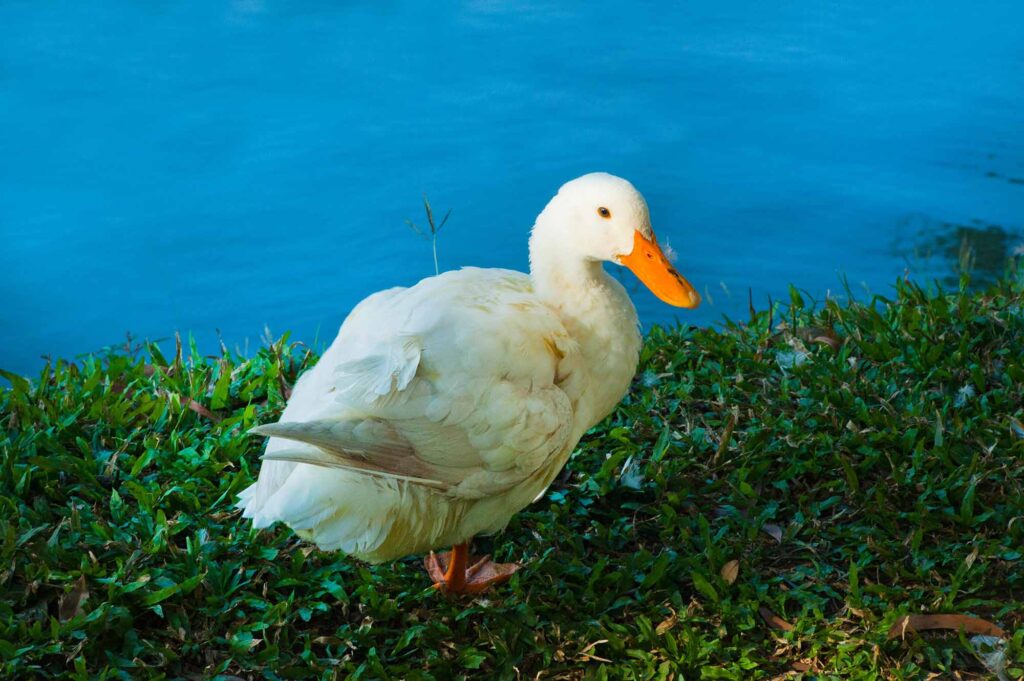
In upstate New York, where the mornings arrived cool and silver and the ponds lay still as held breath, Douglas Brynes did not set out to become a hero. He was simply walking the back road near his home, boots damp with dew, enjoying the sound of nothing in particular.
That was when he heard the peeping.
It was faint at first—thin, urgent, and wildly out of place among the rustle of grass and distant crows. Douglas stopped. He listened. The sound came again, closer now, sharp with panic.
He followed it to the edge of a small pond swollen from spring rain. Near the muddy bank, tangled in reeds and forgotten fishing line, was a baby duck—no bigger than Douglas’s hand, yellow down darkened by water and fear. It flailed helplessly, peeping with all the strength its tiny lungs could manage.
Douglas knelt immediately.
“Hey there,” he said softly. “Easy, little one.”
The duck didn’t understand the words, but it understood the tone. It froze, trembling, eyes bright and round. Douglas carefully worked the line loose, his fingers slow and steady. When the duck was free, it wobbled once, then collapsed into the grass, exhausted.
Douglas scooped it up without thinking, cradling the small, warm weight against his chest. The duck peeped again—this time quieter—and tucked its head beneath his thumb as if it had always belonged there.
He waited for the mother.
Minutes passed. Then more. The pond remained silent.
Douglas sighed. He knew that look—lost beyond rescue by chance alone. He stood, brushing mud from his knees, and made a decision that would change his life in a way both ridiculous and profound.
The duck needed a name.
“Quackers,” Douglas said.
The duck peeped, approvingly.
At home, Douglas set up a makeshift haven with a heat lamp, towels, and a shallow dish of water. He learned quickly—how to feed Quackers, how to keep the water just deep enough, how to listen for the different peeps that meant hunger, fear, or contentment. Quackers followed him everywhere, wobbling after his boots like a shadow that squeaked.
Neighbors raised eyebrows.
Douglas didn’t mind.
Quackers grew—awkwardly at first, then confidently—its down giving way to feathers, its peeps becoming proud quacks that echoed across the yard. It learned the sound of Douglas’s footsteps, the rhythm of his voice, the safety of his presence. When Douglas sat on the porch at dusk, Quackers curled beside him, watching the sky turn pink and gold over the hills.
There was nothing dramatic about it in the end. No headlines. No medals.
Just a man who heard a cry, bent down, and chose to care.
In upstate New York, where the seasons moved slowly and kindness carried far, Douglas Brynes became something unexpected—not because he was brave or bold, but because he was willing.
And Quackers, the baby duck who might have vanished unnoticed into the reeds, grew up knowing one simple truth:
Heroes don’t always wear capes.
Sometimes they wear boots, walk quiet roads, and answer when the smallest voices call. 🦆
In upstate New York, Douglas Brynes became a hero without realizing it the day he brought home a baby duck he named Quackers. What made the story truly remarkable, though, wasn’t just the rescue—it was what happened after.
Douglas already had chickens.
At first, he worried. Chickens were practical, opinionated creatures, and Quackers was small, fuzzy, and entirely convinced Douglas was his parent. But when the time came to introduce Quackers to the flock, something unexpected happened.
The chickens accepted him.
They eyed the duckling with suspicion at first, heads tilting in sharp, judgmental angles. Quackers, undeterred, waddled straight into their midst, peeping cheerfully and settling into the straw as if he had always belonged there. One hen clucked loudly in protest. Another sighed and moved over.
And just like that, Quackers became part of the flock.
He slept in the coop, tucked beneath warm feathers on cold nights. He followed the chickens around the yard during the day, pecking clumsily at the ground and splashing happily in water dishes meant for beaks far less enthusiastic. While the chickens scratched and argued over bugs, Quackers waddled behind them, quacking commentary no one had asked for.
Douglas watched it all with quiet amusement.
The sight was unmistakable: a duck among chickens, different in every way, yet completely at home. The flock adapted. The coop adjusted. Life made room.
As Quackers grew, he never left them. He stood a little taller, splashed a little more, and quacked a little louder, but he still returned to the coop every evening with the chickens, settling in as the sun dipped behind the trees.
Douglas liked to sit nearby at dusk, listening to the soft clucks and occasional quack blend into one familiar sound. He’d come to upstate New York to raise chickens, but he’d ended up with something more—a reminder that family isn’t always about being the same.
Sometimes, it’s just about being welcomed.
And in a quiet yard in upstate New York, a duck named Quackers lived happily ever after with his chickens, thanks to one man who never hesitated to care. 🐔🦆🌲